Lenovo2026-10-20 06:29:16Lenovo, Dell and HP lock in long-term memory supply as PC shipments stabilize, but prices may still riseLenovo, HP and Dell Technologies have signed long-term agreements with memory makers to secure DRAM and SSD supply for next year, according to a report by South Korean media outlet ETNews published on Oct. 19. The move comes after PC vendors spent much of this year dealing with tight memory supply, with one senior industry executive saying actual DRAM and SSD deliveries in the first half reached only 70% to 80% of demand. The agreements are meant to improve supply visibility rather than bring prices down. ETNews said DRAM and SSD prices are still expected to rise next year, though the pace of increases should moderate. When CPU and GPU price gains are included, overall component costs are projected to climb 10% to 20%, lower than this year. At the same time, weaker consumer demand is easing procurement pressure across the supply chain. Omdia said global PC shipments fell 21% year over year in the third quarter and may decline another 7% next year. With the B2C market still soft, PC makers are increasingly leaning on enterprise demand and AI PCs, especially higher-end devices and on-device AI systems that do not require cloud connectivity.40
Acer2026-09-21 04:35:09Acer chairman says consumer DRAM is not in short supply, sees PC prices peaking in H2 2027Acer Chairman Jason Chen said the recent wave of bullish memory pricing guidance from Samsung, SK Hynix, and Micron should not be read as proof of a broad supply shortage. Speaking at the "Principled Management and AI International Forum" hosted by Global Views and Commonwealth Publishing Group, Chen argued that public comments from the three major memory makers function more like market signaling under antitrust constraints than a reflection of actual conditions across the sector. Chen said Chinese memory producers, including ChangXin Memory Technologies (CXMT), hold substantial consumer DRAM capacity and continue to ship at aggressive prices, leaving no real shortage in mainstream products. In his view, supply is ample in segments such as DDR4, while contract pricing has become highly fragmented. He also drew a clear distinction between consumer DRAM and high-bandwidth memory, or HBM, saying China is still unlikely to threaten the HBM market in the near term. On end products, Chen said Acer is building inventory in lower-cost components where possible, but still expects price pressure on finished devices to continue. He estimated fourth-quarter price increases across product lines at 5% to 20%, and said PC retail prices may not stop rising until the second half of 2027. Even then, he said, an outright decline in prices remains uncertain.800
Acer2026-09-20 01:40:04Acer chair says memory shortage has eased, but PC prices still face Q4 increasesAcer Chairman Jason Chen said on the 19th that memory is no longer in short supply, with mainland Chinese suppliers continuing to release volume and disrupting pricing. Contract prices are now fluctuating at elevated levels, with mixed moves across products. Some components, including LPDDR5 and DDR5 9600 paired with N1 or N1X, remain tight, while DDR4 is already oversupplied. CPUs are generally available, except for Small Core specifications used in Microsoft low-license-fee project models. Chen said price increases in key components this year have been unprecedented, pushing customers from complaints to stockpiling. Acer has raised inventory of lower-cost components to cope with the situation, while facing pressure to lift PC prices every quarter. In the fourth quarter, different product lines are still expected to see selling price increases of 5% to 20%. He added that although the three major memory suppliers have signaled optimism that the uptrend could last through 2027, continued output from mainland China means prices are unlikely to keep rising indefinitely. Acer expects its SSD and memory holding costs in 2027 to come in below this year’s level, with a chance for prices to stop rising and stabilize in the second half of next year.630
Intel2026-09-11 02:21:11Intel Raises CPU Prices and Weighs Small Core EOL as Profit Pressure BuildsIntel is pushing through another round of CPU price increases while weighing the retirement of parts of its low-margin Small Core lineup, according to the MarsBit report citing DigiTimes supply-chain sources. The article says Intel began a sustained PC CPU price hike cycle in late 2025 as supply-chain costs rose. Prices were up about 10% in the first quarter of 2026, and some consumer and server CPUs saw another increase in July, ranging from tens of dollars to more than $1,000 per chip. Supply-chain sources quoted by Taiwan-based DigiTimes said Intel’s PC CPUs are expected to rise another 10% on Oct. 5, 2026, while some low-margin small-core products may enter end-of-life procedures. The report frames the move as a deliberate trade-off. Intel is steering capacity and R&D toward higher-margin server CPUs and premium PC products, rather than preserving broad product coverage across every computing segment. That may help profit in the near term, but the article argues it could weaken Intel’s position in industrial computing, IoT, and embedded markets, where long-term supply commitments matter. It also points to rising competitive pressure. Mercury Research data cited in the report shows AMD’s share of x86 client CPU shipments reached 30.3% in Q2 2026, while Intel’s fell to 69.7%, the first time below 70% since 1995.1160
Lenovo2026-08-13 05:18:53Lenovo shares jump nearly 18% after first-quarter revenue beats expectationsLenovo Group shares rose nearly 18% in afternoon trading after the company reported first-quarter results that came in above market expectations. According to the figures cited by Odaily and sourced to The Wall Street Journal, first-quarter revenue climbed 43% year over year to $26.94 billion, ahead of the market forecast of $22.33 billion. Adjusted net profit increased 176% from a year earlier to $1.075 billion. The company said AI-related revenue accounted for 35% of its total revenue during the quarter. Growth in demand for AI servers and Agentic AI applications helped drive near-doubling revenue in Lenovo’s Infrastructure Solutions business, which posted operating profit of $777 million. Lenovo’s smart devices business also recorded 27% revenue growth. Despite a 4.9% year-over-year decline in global PC shipments, Lenovo retained the top position in the global PC market with a 24.2% share. Market data showed the stock surged nearly 18% in afternoon trading following the earnings release.1380
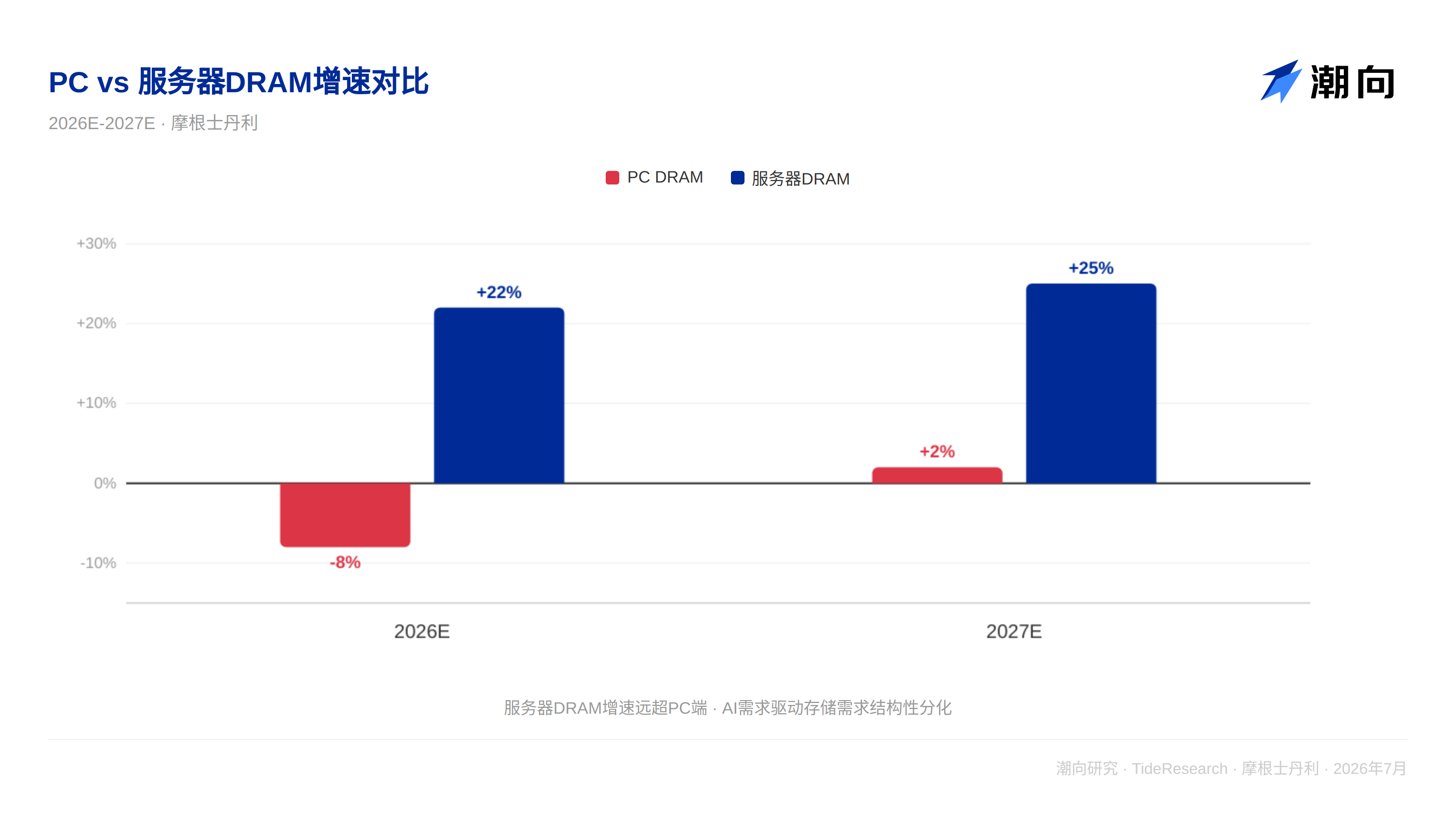
JPMorgan2026-07-16 09:02:54JPMorgan raises server shipment outlook on AI inference demand, while PCs stay under pressure from higher costsJPMorgan raised its global server shipment growth forecasts for 2026 through 2028, arguing that AI inference, rather than training alone, is becoming the main force supporting the market. The bank lifted its 2026 server shipment growth estimate from 15% to 22% and its 2027 forecast from 8% to 25%, saying enterprises need more inference servers as they put AI models into real-world applications. The report drew a clear contrast with the PC market. JPMorgan said first-half PC demand came in better than expected, but attributed that strength to pre-price-hike inventory loading by brands and replacement demand tied to Windows 10, factors it viewed as front-loading demand rather than signaling a durable recovery. For 2026, the bank expects PC shipments to fall 8%, including a 14% drop in consumer PCs and a 4% decline in commercial PCs. JPMorgan also argued that supply, not demand, is the real bottleneck in servers. It said server demand is running 35% to 40% higher year over year, but shipment growth in 2026 can only reach 22% because of constraints in CPUs, substrates, memory, PCBs, passive components and power devices. The report also highlighted uncertainty around Nvidia’s roadmap and said value creation is shifting toward component suppliers.1200